CCTV redaction for local government: meeting the FOI clock
A council answers to a clock that retailers and insurers do not. When a Freedom of Information request lands for CCTV footage, the response is due in twenty working days, it goes to whoever asked without regard to who they are, and in law it is treated as a disclosure to the world. That combination is what makes redaction in local government a category of its own.
The footage itself is rarely the problem. The problem is that a single request can pull material from cameras owned by different departments, each clip can show dozens of uninvolved people, and the standard for release is higher than for a private disclosure because there is no trusted recipient to rely on. Manual masking, frame by frame, does not keep pace with that on a fixed statutory deadline.
Why a council carries a wider redaction load than most
Most organisations hold footage from one kind of camera. A council holds footage from many, and they are owned and operated by teams that rarely sit together:
- Public-space and town-centre CCTV, often monitored alongside the police
- Traffic and parking enforcement cameras, including bus-lane and box-junction capture
- Body-worn cameras on civil enforcement, licensing, environmental and antisocial-behaviour officers
- Housing and estate CCTV, where the same camera serves tenancy disputes, antisocial behaviour and police requests
- Leisure centres, car parks and parks, each with their own retention and access arrangements
When a request arrives, the footage does not arrive with it. Someone has to work out which departments hold relevant material, gather it in the formats those systems export, and bring it into one place before any review can start. The deadline is already running while that happens.
FOI and SAR are not the same request
This is the distinction that shapes everything downstream, and it is easy to get wrong under time pressure. The same fifteen seconds of footage can attract both, and each needs a different treatment.
A subject access request is made by an individual for their own personal data. It runs to one calendar month, and the test is whether the footage is about that person. Other people in shot are third parties whose data has to be protected, but the requester is a known individual receiving their own data.
A Freedom of Information request is different in kind. It can come from anyone, a journalist, a resident, a campaigner, a business, and the council does not get to ask why. Crucially, the answer is treated as a disclosure to the world: once released, it is public. That raises the bar. There is no trusted recipient, so the personal data of everyone identifiable in the footage is in scope for exemption under section 40 of the Act, and the realistic route to releasing anything is often a redacted version rather than a refusal.
The practical upshot is that the FOI version of a clip usually needs heavier and more careful redaction than the SAR version of the same clip, on a shorter clock. A team that prepares one and reuses it for the other gets the balance wrong in one direction or the other.
Where it breaks down for a council team
Volume against a fixed clock. Twenty working days sounds generous until requests cluster after a local incident or a contentious enforcement decision. Manual redaction of multi-camera footage absorbs days that the deadline does not give back.
The to-the-world standard. Because FOI disclosure is public, the cost of getting redaction wrong is higher than in a one-to-one disclosure. An unmasked bystander, a visible number plate, a name on a screen, any of these becomes a public exposure, not a private one.
Footage scattered across departments. Highways, housing, community safety and licensing each run their own systems. Pulling a coherent set of footage for one request, then keeping track of which version went out, is where consistency slips.
An audit trail the ICO would accept. Councils are among the most-complained-about bodies to the Information Commissioner. When a release is challenged, the council needs to show what was disclosed, what was withheld and why. A trail stitched together from email and ad-hoc edits does not hold up well.
How Aetopia AI Redact fits
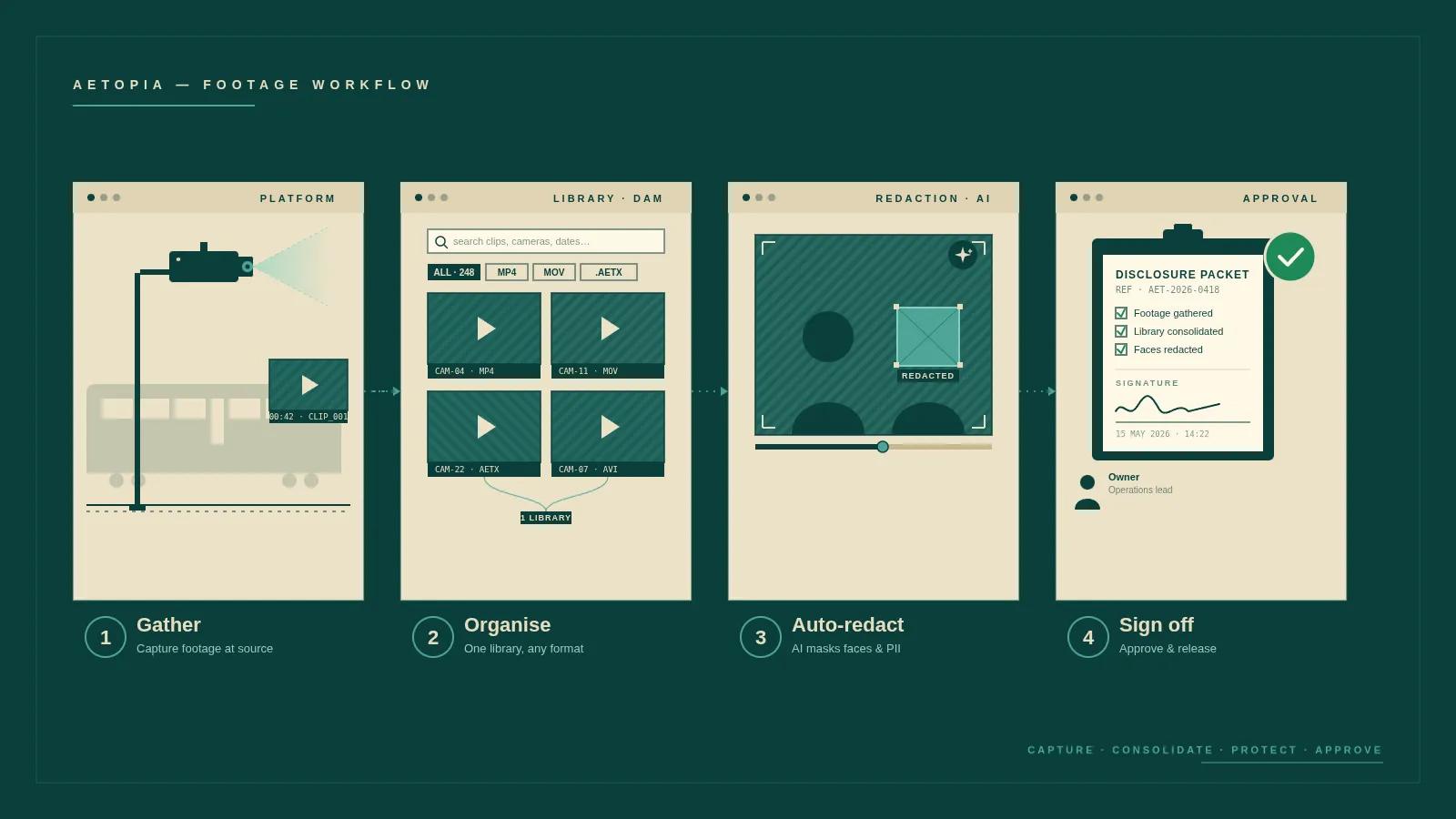
Detect, review, approve, export. One supervised pass.
AI Redact moves the manual-masking step from days of pixel-by-pixel work to a single supervised pass. Faces, number plates, screens and identifying detail are detected automatically; your team confirms before anything leaves the council. The footage from different departments comes into one library first, so review starts from a complete picture rather than a scramble.
For a council team that means:
- Redaction that keeps pace with a twenty-working-day FOI deadline, not one that eats it
- A clear separation between the FOI version, the SAR version and the police version of the same footage
- One master clip per incident, with each audience's version built from it rather than re-edited from scratch
- An audit trail of what was disclosed, what was withheld and why, ready if the ICO asks
It is the same platform UK police forces rely on across millions of evidential assets. The disclosure pattern councils face, the same footage prepared differently for the public, for an individual and for an investigation, is structurally the one AI Redact was built around. See how it works for law enforcement for the fullest version of that story.
If FOI and SAR requests for footage are arriving faster than your team can prepare them, particularly when they cluster after a local incident, talk to us about council redaction. We'll walk through the workflow against a realistic disclosure profile for a UK council, in the formats your CCTV, enforcement and housing systems actually export.
FOI footage requests outrunning your team?
Tell us about your CCTV estate, the departments that hold footage and the FOI and SAR volume you are working through. We'll walk through AI Redact against a realistic disclosure profile for a UK council and show you what the workflow looks like end to end.