Sharing Your Collection Online, On Your Terms: An Interview with Stephen McAreavey
Museums, archives and heritage organisations are under growing pressure to do more with their collections. Audiences expect to explore them online. Media teams want high-quality images when they need them. And many organisations are looking for new sources of income to help fund their work, with digital licensing one of the most practical options.
But putting a collection online raises its own questions. How much should people be able to see and download? How do you protect your high-resolution files? And how do you keep a public website safe when bots and AI crawlers are harvesting anything they can reach?
In this interview, Stephen McAreavey, Commercial Director at Aetopia, explains what the new public portal for Aetopia DAMS can do, why it was designed the way it was, and what comes next.
How would you describe the Aetopia eCommerce system to a customer?
The Aetopia eCommerce module is a dedicated public portal, and it is an add-on to a customer's DAMS (digital asset management system). It is designed to live on the public internet and act as the shop window for any digital assets a customer wants to push out to the public.
It is suitable for any size of collection, from a single individual's work to a large institutional archive. It allows the public to browse and search assets in a secure and controlled way. You can enforce watermarking, and you can control thumbnail sizes and quality levels, so you decide exactly how much access people get to your digital assets.
Its first purpose is to give access to the parts of your collection that you want to surface publicly. There are many reasons organisations want to do that, and many audiences they need to serve. It might be members of the public who simply want to look at your collection, or the media, where high-quality imagery supports PR and media content.
What can institutions actually do with it?
There are a few main options. The most basic is browsing and viewing. Imagine you run a gallery and want to encourage people to visit. You may not be licensing your images for use outside the gallery, but publishing them online lets people search and browse your collections, and that can bring them through the door.
The next option is selling. Whatever digital assets and images you hold, you might want people to buy them. That can become a commercial revenue stream. Many high-quality artworks and images are desirable for use in books, advertising campaigns, loans, exhibitions and posters, so there are many scenarios where a digital licence is valuable.
Put simply, the main reasons to deploy a public portal are:
Digital licensing.
This is a revenue-based use case and is very important to many organisations. The portal supports it well.
Publishing permanent or semi-permanent collections online.
This gives the public a standing way to explore your holdings.
Offering easy download of entire collections.
Some customers sell rights not to individual images but to whole collections. For example, a video games company might negotiate a fee with an external partner and then download an entire collection, potentially 1,000 images, in one click.
Not every use case involves digital licensing. Some organisations use the portal purely for publicity, encouraging people to visit or see the collection in person. That is less common, because most organisations already have a website that handles this, but it is still possible.
Is it mainly for image licensing, or can it be used for anything?
It is open to a wide range of customers, and it can be adapted to whatever a customer wants to do. Licensing is the most common use case, and every customer has different requirements. When a group of customers shares the same requirements, that is a market, and there is a strong market for digital licensing, where organisations are looking for alternative revenue streams to help fund their operations.
Does an institution need to be using Aetopia DAMS to use the eCommerce portal?
Yes, but not exclusively. The public portal is a module of Aetopia DAMS, so to use it, an organisation has to deploy Aetopia DAMS as well. That does not stop them from having another system. They would only need to upload into Aetopia DAMS whatever they intend to publish on the eCommerce portal.
We think of the portal as a public portal with an optional eCommerce element. Some customers will deploy it without eCommerce, and others will deploy it with eCommerce.
How is the public site kept separate from the internal system?
Our model is two separate web applications connected to the same system, so it is still one system. The internal administration site is used for managing the archive and can be protected and accessible only internally. The public site is built to be publicly accessible, and all of the admin functions have been removed from it. It is effectively a read-only portal, so it can be placed on the internet and accessed from anywhere without giving visitors any way to change anything on the administration side.
This separation also helps with security. Bad actors have very little to work with, because the eCommerce portal has none of the administrative functions to begin with.
What makes Aetopia's eCommerce system special?
We designed eCommerce from the ground up, specifically for the modern web. The internet now has a busy landscape of bots and AI crawlers that aggressively harvest publicly available material. Many traditional systems combine the internal administration side and the public side into one system, which creates problems. Aetopia's design keeps those two sides deliberately separate. It is a completely modern design, built in-house by Aetopia, to work well in today's internet landscape.
For existing Aetopia customers there is a second advantage. Because the eCommerce portal is an add-on to the current Aetopia product, it works with your existing DAMS. Switching it on is a very small change to your internal DAMS, which simply enables the admin functions needed for the public portal. That means the portal can be deployed quickly.
How quickly can an organisation get up and running?
We can spin up a public portal website in as little as a week. That may not cover every eCommerce element, such as price books, which need more time to discuss and implement. But in many cases the core functions can be live in that time. We are also using AI to help with this.
Does the design work come included?
Yes. Web design used to be one of the major cost elements, because the public portal had to be made to fit the customer's brand. We now use AI to do that very effectively. We take care of the web design as part of the package, so the portal matches the customer's existing public presence. That reduces the cost for the customer and dramatically shortens the time to go live.
Where is the eCommerce product today?
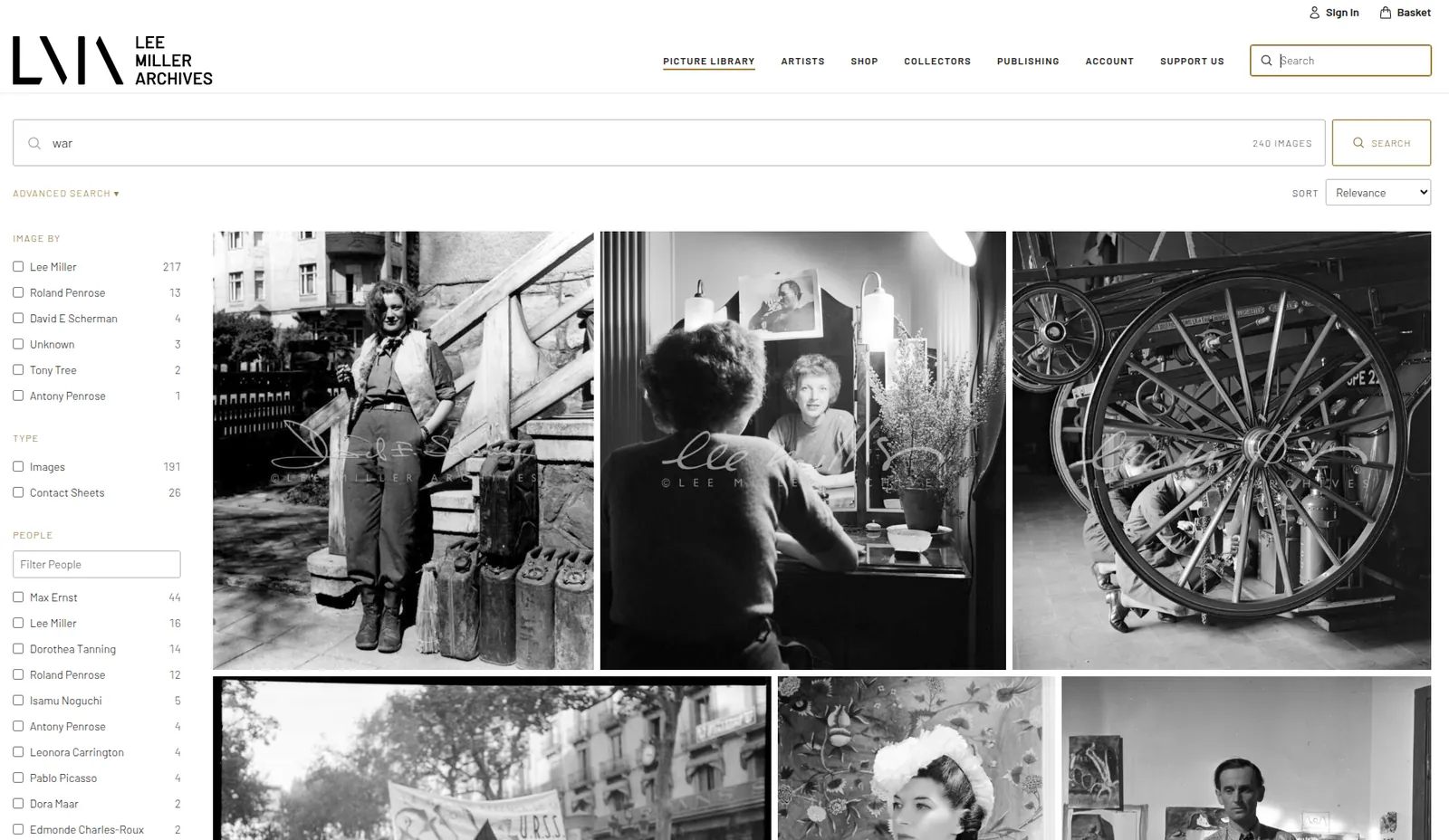
We have been working with two lead customers, and the first is already live. Our customer the Lee Miller Archives has launched its upgraded online store on the portal, with a new payment integration, enhanced image licensing and stronger protection against AI-driven bots.
We are very excited to launch the second before the end of 2026. That is where our focus is right now: getting everything in place so more organisations can go live with this brand-new product.
What is the roadmap beyond that?
We have an exciting roadmap ahead. The portal is a brand-new product, and we are looking forward to adding a number of new features throughout 2027, shaped by what our customers tell us they need. Watch this space.
Sharing your collection, on your terms
For many organisations, the question is no longer whether to share their collections online, but how to do it without giving up control. Keeping the public portal separate from your internal system means you decide what is visible, at what quality, and on what terms it can be licensed. Meanwhile, the management of your archive stays protected behind the scenes.
If you already use Aetopia DAMS, the portal works with your existing system, so enabling it is a small change rather than a new project.
Thinking about publishing or licensing your collection?
We're happy to show you how the portal works, using examples similar to your own collection. No sales pitch. Just a practical conversation.
Book a walkthrough