
Public Record Office of Northern Ireland
Preserving records of historical, social and cultural importance.
PRONI needed to protect 20,000 pages of fragile 19th-century Belfast Street Directories from physical damage, while making them fully searchable and accessible to the public online.
The background.
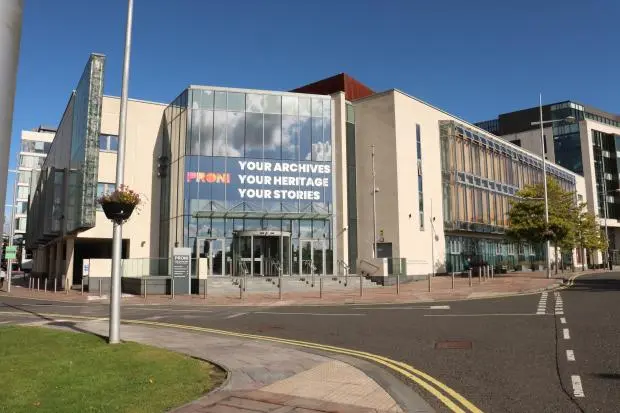
The Public Record Office of Northern Ireland (PRONI) is the official archive for Northern Ireland, holding responsibility for preserving records of historical, social and cultural importance and making them available for the information, education and enjoyment of the public.
Among PRONI's most heavily used resources are the Belfast Street Directories, spanning 1819 to 1900. These 30 volumes contain the names, addresses and occupations of inhabitants across Northern Ireland alongside records of commercial establishments. They are invaluable to historical and genealogical researchers worldwide.
With 20,000 pages of fragile paper at risk from constant public handling, PRONI needed to digitise the entire collection, build a searchable public interface, and ensure the originals would never need to be touched again.
The challenge.
Four problems the project needed to solve.
Fragile physical volumes at risk
20,000 pages of irreplaceable 19th-century documents were deteriorating through constant public handling. Some pages had already been lost or damaged, and further use threatened their long-term survival.
Poor quality OCR limiting search
An earlier digitisation project had produced low-accuracy OCR text and poorly skewed scans. Search results were unreliable and the system could not highlight where search terms appeared within a document.
Complex, difficult public interface
The original public-facing website forced users through a complex advanced search before seeing any results. Public feedback indicated the experience was difficult to navigate, particularly for non-specialist researchers.
No infrastructure for public demand
The original system had no ability to scale for traffic spikes. When the site attracted press coverage at launch, the infrastructure was unable to handle demand, limiting public access at the most critical moment.
By re-implementing PRONI's digital archive with advanced cloud OCR, intelligent search and scalable AWS infrastructure, Aetopia transformed 20,000 pages of fragile, at-risk documents into a fully searchable public resource, protecting the originals from further damage while opening 81 years of Northern Irish history to researchers worldwide.
The work, step by step.
From fragile volumes to a fully searchable public archive.
Metadata analysis and taxonomy design
Aetopia analysed and cleaned the existing metadata across 30 directories, correcting transcription errors and building a structured taxonomy covering 250 locations and 11 section types. This clean foundation made the entire collection consistently discoverable.
Advanced OCR reprocessing with ABBYY
All 10,000 scans were reprocessed through ABBYY's cloud OCR, producing de-skewed PDFs with embedded text layers and precise positional data for every word. This replaced the original low-accuracy output and enabled search-term highlighting at pixel level within the browser.
Intuitive public search interface
The complex original interface was replaced with a single search box and facet filtering, letting users drill into results by directory, section and location. Colour-coded search-term highlighting overlays made it easy for researchers to identify relevant entries at a glance, across both standard and zoom views.
Secure, scalable AWS deployment
The system was deployed on a 3-tier AWS infrastructure, allowing rapid scaling when the site launched to press coverage and demand spiked sharply. As a government system, it also underwent independent penetration testing by a CESG-approved provider and passed with no significant findings.
The results.
Aetopia Digital Collections
Built for archives, museums and heritage organisations.
Aetopia's digital collections platform helps cultural and public sector organisations preserve, organise and open their collections to researchers and the public, with the governance and security their holdings demand.